Green Blindspot: The Environmental Compliance Costs US Firms Are Discovering Too Late in Taiwan
For many US companies, the decision to manufacture or source from Taiwan has historically been framed around two variables: cost efficiency and technical capability. Environmental compliance rarely enters the conversation until it has to—and in Taiwan's rapidly shifting regulatory landscape, that moment is arriving far sooner than most American executives expected.
Taiwan's Environmental Protection Administration, now restructured into the Ministry of Environment following a 2023 government reorganization, has been systematically strengthening the island's environmental governance architecture. What was once a relatively permissive operating environment for industrial activity has evolved into a multi-layered compliance regime that increasingly mirrors the rigor of European sustainability standards. US firms that built their Taiwan strategies around decade-old assumptions are finding that the ground has shifted beneath them.
The Regulatory Architecture Most US Firms Haven't Mapped
At the center of Taiwan's environmental evolution is its Climate Change Response Act, enacted in 2023. The legislation establishes a domestic carbon pricing mechanism and introduces mandatory greenhouse gas (GHG) disclosure requirements for a broadening set of industries. While the initial compliance targets focus on large domestic emitters, the framework's scope is expanding—and the supply chain implications for foreign-invested enterprises are significant.
US companies operating manufacturing facilities in Taiwan are increasingly subject to emissions inventory requirements, third-party verification mandates, and facility-level reporting obligations that many have neither budgeted for nor staffed toward. Beyond carbon, Taiwan's air pollution control regulations, effluent discharge standards, and industrial waste management rules carry their own inspection cadences and penalty structures. For US firms accustomed to federal EPA frameworks, the assumption that Taiwanese standards are broadly comparable—or less demanding—has proven to be a costly one.
The compliance burden is compounded by a fragmentation problem. Environmental obligations in Taiwan are distributed across national legislation, municipal-level enforcement, and industry-specific administrative guidelines. A US manufacturer operating in Taoyuan faces a different enforcement posture than one operating in Kaohsiung, where industrial zone oversight has historically been more aggressive. Without local regulatory counsel embedded in operations, these distinctions are nearly impossible to track from a US headquarters.
Where Audit Risk Is Concentrating
Taiwan's environmental enforcement agencies have expanded their inspection capacity over the past three years, driven in part by domestic political pressure to demonstrate credible climate action ahead of international reporting deadlines. The practical result is a higher frequency of facility audits, a lower threshold for issuing corrective action notices, and a more systematic approach to tracking repeat violations.
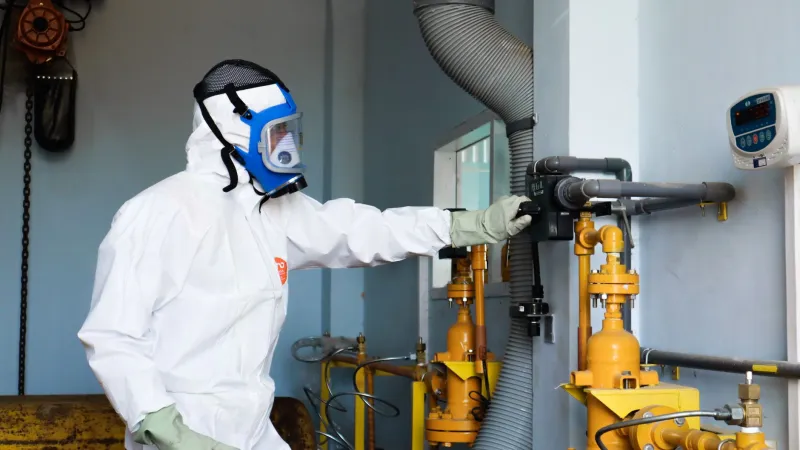
For US companies, the audit risk is concentrating in several specific areas. Solvent and chemical handling compliance—particularly relevant for electronics assembly and precision manufacturing operations—has drawn heightened scrutiny. Wastewater treatment verification for firms in the semiconductor supply chain has become a routine audit trigger. And GHG reporting accuracy, as Taiwan's carbon accounting infrastructure matures, is emerging as a new frontier for regulatory examination.
The financial exposure is not trivial. Administrative fines under Taiwan's Air Pollution Control Act can reach NT$20 million per violation—approximately $620,000 USD at current exchange rates—with daily penalty accruals for uncorrected violations. More consequentially, firms that accumulate environmental compliance failures risk permit suspension, which can halt production and trigger contractual penalties with downstream customers entirely separate from the regulatory fines themselves.
The Carbon Accounting Dimension US Exporters Are Underestimating
Beyond facility-level compliance, US companies exporting from Taiwan to European markets face a compounding pressure point: the EU's Carbon Border Adjustment Mechanism (CBAM). As CBAM's transitional phase moves toward full implementation, the embedded carbon content of goods manufactured in Taiwan and exported onward to Europe becomes a direct cost variable. US firms that lack granular emissions data from their Taiwan operations—data that Taiwan's own regulatory framework is now beginning to require—will find themselves unable to accurately calculate CBAM liabilities, a gap that auditors and trade compliance officers are increasingly flagging as a material risk.
This creates an unusual alignment between Taiwan's domestic environmental requirements and the external trade compliance obligations of US multinationals. Firms that invest in building robust GHG accounting infrastructure for their Taiwan operations are, in effect, simultaneously de-risking their European export exposure. The companies recognizing this dual-use value are moving faster—and more strategically—than those treating Taiwan environmental compliance as a purely local administrative matter.
How Early Adopters Are Building Competitive Distance
A subset of US firms—concentrated primarily among larger technology manufacturers and consumer goods companies with established ESG reporting functions—has begun treating Taiwan environmental compliance as a source of commercial differentiation rather than a cost center. The logic is straightforward: as Taiwanese contract manufacturers and suppliers face their own escalating compliance obligations, they increasingly prefer customers whose operational requirements and reporting standards are already aligned with regulatory direction.
US companies that have invested in ISO 14001 certification for their Taiwan operations, implemented facility-level carbon tracking systems, and established clear supplier environmental qualification criteria are reporting measurably shorter procurement cycles with Tier 1 Taiwanese manufacturers. In a market where supply relationships are built on trust and operational compatibility, demonstrating environmental credibility has become a soft power asset that earlier-stage US entrants are only beginning to appreciate.
Some firms are going further, embedding environmental performance metrics into their Taiwan vendor scorecards and conditioning contract renewals on documented compliance improvement. This approach not only insulates US buyers from downstream liability associated with supplier violations—a genuine legal exposure under Taiwan's extended producer responsibility provisions—but positions them as preferred partners in a market where regulatory-compliant capacity is becoming scarcer and more valuable.
Practical Steps for US Firms Operating Behind the Curve
For US companies that have not yet conducted a structured review of their Taiwan environmental compliance posture, the starting point is a gap assessment calibrated to current Taiwanese regulatory requirements rather than extrapolated from US or international equivalents. Engaging local environmental legal counsel—distinct from general commercial counsel—is essential, as the technical specificity of Taiwan's environmental statutes demands specialized expertise.
Operationally, firms should prioritize establishing baseline GHG inventories for Taiwan facilities, even where mandatory reporting thresholds have not yet been triggered. The regulatory trajectory is clearly toward broader coverage, and building internal data infrastructure ahead of legal requirement is substantially less disruptive than retrofitting it under enforcement pressure.
Finally, US companies should revisit their Taiwan supply contracts to assess indemnification language around environmental liability. As enforcement activity increases, the risk that a supplier's compliance failure creates exposure for a US buyer is no longer theoretical—it is a scenario that legal and procurement teams need to have explicitly addressed.
Taiwan's environmental regulatory evolution is not a distant policy development. For US firms with active operations on the island, it is a present-tense operational challenge—and for those willing to engage it seriously, an underappreciated source of strategic advantage.